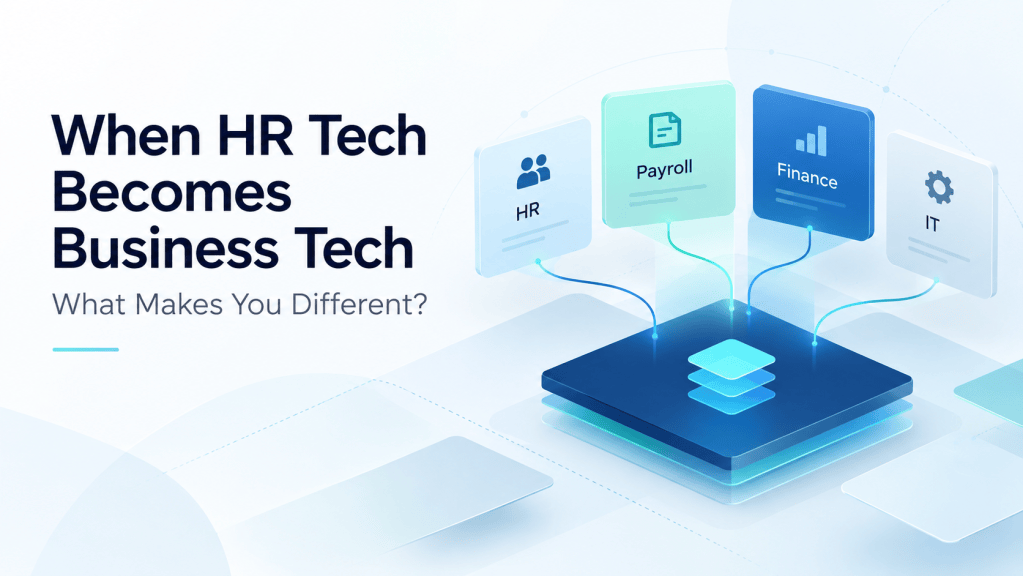
HR tech is getting bigger, but the software in it are getting harder to tell apart.
Paylocity has moved beyond HR and payroll into Finance and IT. Rippling connects HR, payroll, IT and Finance. Workday now talks about itself as a platform across HR, finance and IT. Deel has expanded from global hiring and payroll into HRIS, talent, workforce planning, IT, benefits and more.
A decade ago, it was easier to answer, “What category is this company in?” Now, not so much.
The bigger question isn’t whether HR tech companies are adding more products. They are.
It’s this: Are we still building HR and payroll platforms, or are we building business systems with people at the center?
If every vendor starts selling some version of HR, payroll, Finance, IT, workforce planning, spend and AI, doing more stops being much of a differentiator.
There’s a good reason this is happening
Buyers are tired of disconnected systems. G2 found that 69% of organizations still operate across fragmented HR environments that require manual reconciliation, while only 18% said they’d reached a unified single-system setup.
The employee lifecycle already extends far beyond HR. A new hire affects payroll, IT, Finance, security, headcount and budgets. The same is true when someone changes roles, moves or leaves.
So it makes sense to connect more of those processes around the same employee data. That’s the logic behind platforms like Rippling, and it’s part of why Paylocity’s acquisition of Airbase pushed it beyond HR and further into Finance.
HR tech becoming business tech isn’t the problem.
The positioning challenge that comes with it is.
Every new category brings new competitors
The minute HR software moves into Finance or IT, it changes who it’s competing with.
Add identity management and IT brings its own vendors and expectations. Add AP automation and you’re competing with finance tools.
Your reputation in HR can help you get into those conversations, but it won’t automatically win them.
Deel is a good example of expansion that still has a clear thread. Its portfolio is much broader now, but global workforce infrastructure still gives the company a reason all those products fit together.
That’s the difference between adding products and expanding your position.
One gives you more to sell. The other makes what you’re already known for more valuable.
More features aren’t a position
HR tech already has a sameness problem.
After HR Tech 2025, 3Sixty Insights wrote about how similar vendor messaging had become, especially around AI. Companies were talking about many of the same capabilities and giving buyers very little help understanding why one was meaningfully different from another.
Broader platforms can make that worse.
“All-in-one” isn’t a position. “Unified” isn’t a position. Neither is connecting HR, Finance and IT if several competitors can say the same thing.
Those may all be useful capabilities, but they still don’t answer the question buyers care about:
Why you?
Your product portfolio tells buyers what you sell. Your positioning needs to tell them why your version matters more.
You still need a center of gravity
Every platform needs an anchor. Something that explains why all these products belong together and why your company should be the top pick.
For one company, that might be complex payroll for construction. For another, frontline workforce operations. For another, global employment. Another might build around the employee record and use it to connect HR, Finance and IT.
The point isn’t that companies shouldn’t expand. It’s that expansion should strengthen what makes them valuable, not water it down.
This is where companies get themselves into trouble. The product gets broader, so the messaging gets broader too. More products, more personas, more use cases, more internal teams that want their piece included.
Eventually, the positioning says everything all at once.
As the platform gets bigger, the positioning holding it together should get sharper.
Business platforms have to differentiate twice
Once you move beyond HR, you’ve got two jobs.
First, each product has to be credible in the category it’s entering. Nobody’s going to lower their standards because the product sits inside a broader HR platform.
Second, you need to explain why those products are better together.
“We have all of these things for your business” is a feature argument.
The stronger argument is: “These things work better together because of an X advantage we have that others don’t.”
That advantage might be your data, your architecture, your expertise, the audience you know best or the problem you’ve already proven to solve.
Bigger platforms need sharper positioning
This expansion isn’t going to stop. Buyers want fewer vendors and systems. AI makes connected data more useful. Vendors want a stickier customer.
But the more a software can do, the more disciplined it has to be about what it wants to be known for.
What’s the advantage connecting the portfolio of products? Why does this new category make sense for us? Does this product strengthen what buyers already know us for, or pull us further away from it? If competitors can build or buy the same functionality, what’s still ours?
HR tech may be turning into business tech.
But if every HR tech company eventually becomes some version of a business platform, doing more won’t be enough.
The real challenge will be getting bigger without becoming harder to understand.