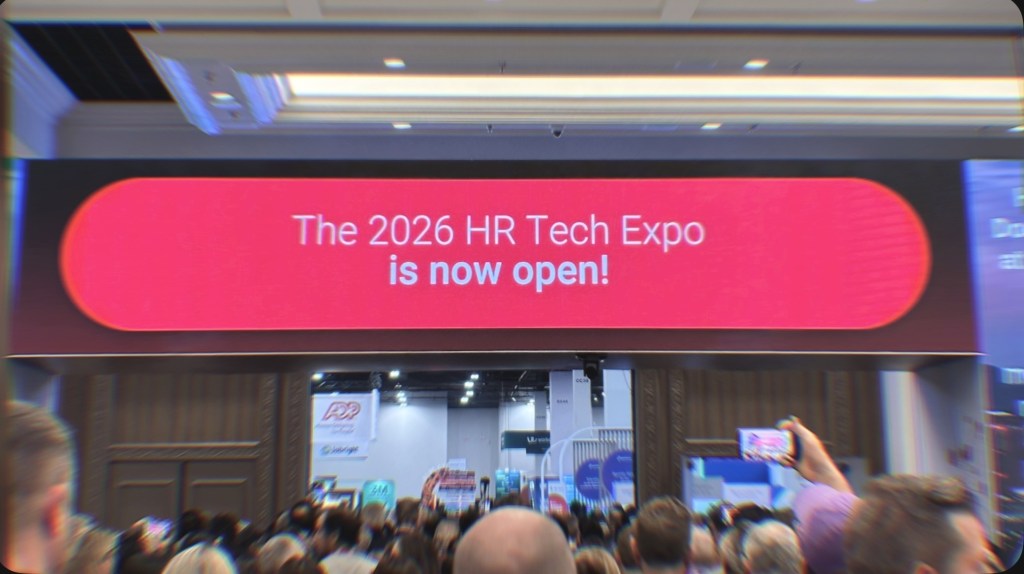
Another HR Tech for the books.
It was good to see more energy and familiar faces this year after what was a more muted conference last year. Maybe bumping the event from September to October did really change things.
After sitting down with over 20 different vendors and walking the expo floor, a few themes emerged:
An Atmosphere of Curiosity
There were way fewer slide decks this year and a much bigger desire to exchange ideas. Something must’ve been in the air, because vendors were more curious than ever. It could be because 3Sixty Insights has become a familiar face, but maybe because there’s been a (welcome) tone change in how vendors interact with analysts.
After HRTechs in 2024 and 2025, where I felt we analysts were being told what we should care about, much of this year’s conference was us being asked what we’re seeing out there, followed by a conversation.
Top-Down vs. Bottom-Up Needs
In an industry where a million fingers are in the air trying to figure out which way the wind is blowing, it seems to me that many of the industry’s top marketers are hamstrung by safe, trendy marketing decisions.
The messaging I was seeing and hearing on the expo floor still often feels like it’s born in a boardroom by a panel of technologists and PE executives rather than by the many creative marketers and thinkers sitting across the table from me.
What is MCP? What is an outcome? Who cares is what.
Every year I hear more and more language that probably gets investors hot around the collar—and maybe that’s all that matters to some—but doesn’t help a customer schedule an interview or pay their people. Solving business problems should be priority number one before starting Computer Science 101.
“The product is just a byproduct of what the customers need” was a line spoken by John Deal during our briefing with Phenom, and I think that sums up what the real goal always should be.
AI ROI
As part of my soon-to-be-released 2027 research agenda, I’ve been putting together ideas about pressures on executive teams to show AI ROI. But while I was sitting there speaking to a vendor about this very topic, I began to wonder if fundamental AI ROI is even going to be that challenging to achieve.
With AI functionality quickly showing up everywhere, the main issue will be how to effectively distill and measure it rather than deploy and use it. Deploying it and using it are the easy parts, as AI is cheaper and more ubiquitous than ever. Governance and security—how well you can deploy a contained AI that you really can feel data ownership for—are going to be the much bigger hurdles. Also, with AI at a reduced price, it’s less of an overhead investment to justify. No one is justifying why they have internet access or use Google Search. At this point, it just is.
“Outcomes” & The Napster Effect
While AI ubiquity is good news for leadership and good news for AI companies trying to get AI onto every computer system, it’s going to heighten the challenges around using AI over unharmonized data or over systems that aren’t ready for it, either because they’re out of date or their data isn’t clean.
With many vendors mentioning how they want to set AI pricing based on “outcomes,” AI utility and accuracy make defining them murky at best. As was brought up during our meeting with Lytiqs, there’s a greater need to educate the market on certain terms and the purpose behind them.
Still, I think vendors will have a hard time defining what an outcome is. Clients may push back on what defines a quality result. In the end, it seems like extra work for vendors instead of just building in a flat cost for AI into the model, as was mentioned in our discussion with Opal Wagnac and Samrat Krishna of Darwinbox, where they spoke about how they want to offer a flat fee for AI so people can experiment and find value first, giving the buyer more of a seat at the table when it comes to pricing and usage.
Lastly, regarding the use of tokens, HR tech and the AI-powered tech market more broadly need to be careful not to cause a bootleg cable/Napster effect when it comes to AI tokens. I said last year that if you give AI away for free from the get-go, it’s going to be hard to put that genie back in the bottle. But they sure are trying. If you force people to pay, not only may they go elsewhere where it’s free, but it’s also going to drive some to a gray or black AI market, or they’ll just stop using it.
Closing
Thank you to our sponsors, Insperity, Tavio, Paylocity, and LYTIQS, for sponsoring the 3Sixty Insights team at HR Tech this year.
And thank you to everyone who made time to brief the 3Sixty Insights team in Las Vegas, including the teams at Darwinbox, Cornerstone on Demand, Keka, Vervoe, PrismHR/Vensure, Lightcast, Multiplier, Strada, Paychex, Alight, SAP, Paylocity, Lytiqs, Phenom, Tavio, PosterElite, Guild, and Vetty.