I spent this past week at Conga Connect 2026, speaking with customers, executives, and operators across the revenue ecosystem. The brand reveal will likely be the moment most attendees remember from the event. I covered that story separately. But in conversations with operators and revenue leaders throughout the week, a different set of signals stood out.
They all pointed to the same underlying challenge: revenue teams are still struggling with friction inside the deal process.
During the opening session, Conga CMO Celia Fleischaker shared several statistics that framed the scale of the problem.
- Only 8% of organizations report strong confidence in their pricing decisions.
- 45% say they lose deals due to slow quote approvals.
- 72% report that slow contracting increases risk and compliance exposure.
- And perhaps most telling, 93% say deals struggle to move smoothly through the commercial process.
(You can download the full report that this data and much more came from here)
Those numbers help explain why the conversations at the conference repeatedly returned to the same themes. Across industries, companies are rethinking how revenue workflows operate and how decisions move through the system.
Three signals in particular stood out.
Signal 1: The Rise of the Commerce Chain
Revenue execution is increasingly being treated as a system design problem rather than a departmental one.
For years, companies organized commercial operations around individual teams: sales owned the opportunity, finance owned pricing, legal owned contracting, and operations attempted to stitch everything together after the fact. Even with the rise of Revenue Operations and the CRO role, the underlying systems supporting those workflows often remained fragmented.
The result is the friction reflected in that 93% statistic. Deals move from one system to another, approvals require multiple handoffs, and decision context gets lost along the way.
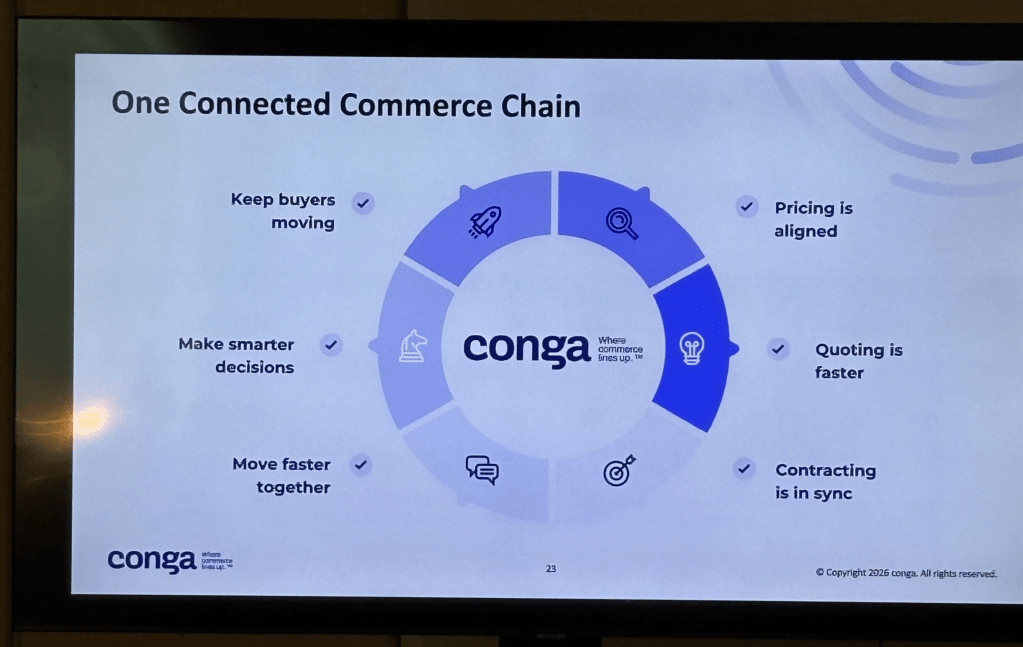
Conga’s response to this challenge is what it calls the Commerce Chain, a framework that connects pricing, quoting, approvals, contracting, and revenue execution into a single workflow, but the underlying idea reflects a broader shift in how revenue teams are designing their systems.
Whether organizations use that exact terminology or not, the idea reflects a broader shift. Revenue leaders are increasingly thinking about the entire commercial process as a connected system rather than a series of isolated tools.
RevOps is no longer just an organizational model. It is becoming an architectural one.
Signal 2: Pricing Intelligence Is Moving Upstream
Another theme that surfaced repeatedly during the conference is the changing role of pricing.
Historically, pricing decisions often appeared late in the sales cycle. Sales teams would structure deals first, and pricing approvals or adjustments would happen near the end of the process. That model worked when markets moved more slowly and pricing structures were simpler.
Today, that approach is increasingly unsustainable.
Modern buyers expect more transparency earlier in the buying process, even in complex B2B environments. At the same time, organizations are dealing with growing pricing complexity across regions, currencies, tariffs, and product configurations. Companies can no longer rely on manual pricing reviews late in the deal cycle.
The statistic Fleischaker shared illustrates the magnitude of the issue: only 8% of organizations report strong confidence in their pricing decisions.
That lack of confidence is pushing pricing intelligence further upstream. Instead of acting as a reactive approval step, pricing is becoming part of the strategic conversation earlier in the deal process. Modern revenue platforms are starting to incorporate pricing models, margin guidance, and market signals directly into the workflow so sellers can structure viable deals from the outset.
The goal is not simply to automate pricing. It is to make pricing intelligence available earlier, where it can shape better decisions.
Signal 3: AI Is Becoming Embedded in Revenue Workflows
AI was present throughout the conference, but not in the way many people might expect.
Rather than appearing as standalone AI tools, the technology is increasingly embedding itself inside existing revenue workflows. The practical applications discussed at the event were less about generative content and more about operational assistance.
AI is beginning to support tasks such as analyzing deal structures, recommending pricing adjustments, summarizing contracts, and helping teams navigate approval processes. In other words, it is showing up where decisions are being made.
This matters because one of the biggest sources of revenue friction is approval speed. According to the data shared at the conference, 45% of companies report losing deals due to slow quote approvals.
Embedding AI into these workflows helps reduce that friction. When systems can surface context, summarize risk, or suggest viable pricing structures, teams can move through approvals more efficiently while still maintaining the appropriate guardrails.
The technology is not replacing the decision-makers. It is helping them move faster with better information.
The Bigger Shift: Revenue Teams Are Optimizing for Decision Speed
Taken together, these signals point to a larger shift happening across revenue organizations.
Companies are increasingly designing their revenue systems around decision speed.
The Commerce Chain connects workflows so deals move without unnecessary handoffs. Pricing intelligence moves upstream so sellers can structure viable deals earlier. AI assists with analysis and approvals so teams can move faster while maintaining governance.
Legal and contracting workflows are also part of this equation. Several conversations during the conference highlighted how slow contract reviews can stall otherwise healthy deals. When systems can summarize agreements, surface risk areas, or accelerate approvals for common documents such as NDAs, the entire process becomes more fluid.
The statistic Fleischaker shared about contracting highlights the stakes: 72% of organizations say slow contracting increases risk and compliance exposure.
Speed, in this context, is not about rushing deals. It is about reducing the latency between information and decision.
When revenue systems provide the right context at the right moment, sellers can operate more entrepreneurially. They can structure deals with confidence, navigate approvals more efficiently, and move opportunities forward without waiting for fragmented systems to catch up.
That shift may ultimately be the most important signal from Conga Connect this year as it is a pattern we are seeing across multiple revenue technology conversations this year.
The technologies discussed at the conference (pricing platforms, workflow orchestration, AI assistants), are all pieces of a larger effort to remove friction from the revenue process.
The goal is simple.
Help organizations make confident decisions faster, and help deals move through the system the way they were always intended to.