I was introduced to Plum’s Discovery Survey tool by Michelle Meehan at HR Tech last week. Michelle and I had a great conversation about the outdated work structures that are affecting both employee experience and productivity. We touched on the need to rethink the traditional 40-hour work week, which, as it approaches its 100th anniversary in 2026, is long overdue for retirement—especially in many modern professions.
Propelled faster by the pandemic, changes in technological efficiency, new work-life standards, and the values of younger workers have pushed this trend along to the point that it has to be a major part of the conversation when discussing employee experience and overall business optimization.
Another noteworthy factor in all of this is how businesses are turning more towards skill-based hiring and focusing on an individual’s strengths and weaknesses within a workforce. Since hiring has become incredibly competitive, especially at companies that want the best talent, there needs to be some accommodation to how different people work.
The idea of “ownership” is a big issue with the 40-hour work week. While many job descriptions do have explicit hourly constraints, such as shifts for hourly workers, most people in salaried positions work in what is essentially project-based employment. They are hired to perform certain tasks within a certain scope of duties, typically with fleshed-out deadlines or timeliness in which they are due.
If businesses are going to pivot towards skills-based hiring, then they also need to justify what those skills are being hired to do. This may mean anchoring work in projects or objective-based benchmarks with deadlines and a firm cap on work hours instead of an open-ended schedule that eats 8 hours of your just because your boss told you so. Full-time employment would become akin to a lawyer on retainer with a defined term of work with outlined compensation and benefits, but employment that is contingent on a specific skill set. Pay remains the same whether it’s busier or slower, but there is a cap to the amount of work that can be done as part of this engagement.
This helps alleviate the mundane hours where you have to work – or pretend to and be bitter about it – because someone ‘owns’ your time and makes realistic deadlines (it would be easy to abuse this form of work otherwise) while also allowing for the flexibility to optimize the workday to the schedule that allows that individual worker to be their most productive when needed. Effective management and tracking would be essential in all of this, which is why managers must be selected carefully while enabling them to keep their workforce accountable.
While it’s true that great minds may (sometimes) think alike, it’s equally true that many do not work alike. Some work faster, some slower, some at night, and some need breaks more often than others. Exceptional minds may need exceptional work environments in order to thrive, and forcing them into a strict pattern of work may not be the most innovative way to get results.
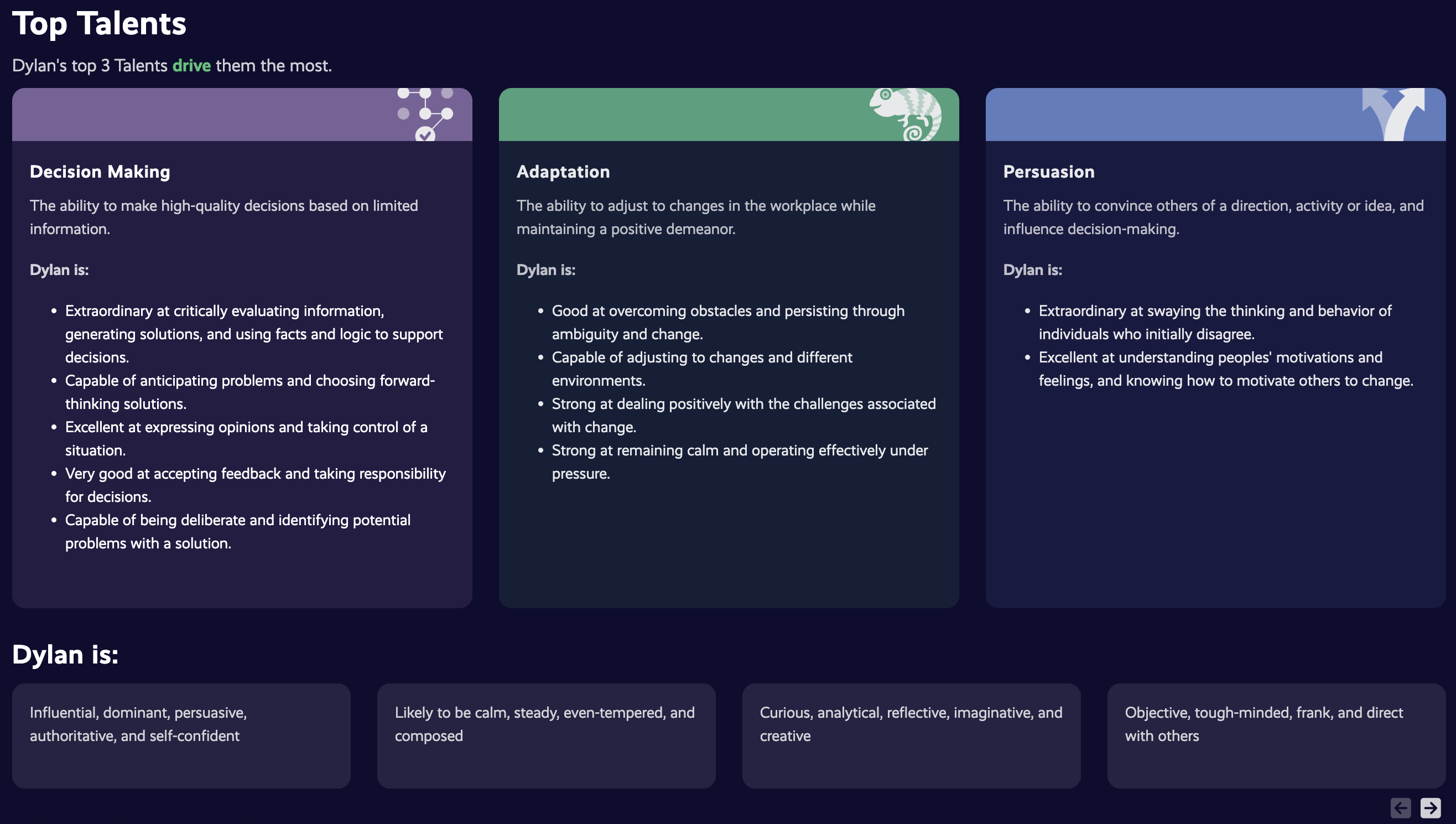
This is where Plum’s Discovery Survey can truly make a difference. It and tools like it help us understand how we work, what motivates us, what our blind spots may be, and what we could work on to improve them, and how that all plays into one’s present and future at an organization.
Tests like this need to be taken with a grain of salt, of course. People are not static and change constantly. Just because you aren’t naturally good at math doesn’t mean that with some hard work you could be. However, it gives a remarkable snapshot of where and how a person falls into an organization. When you perform these at a macro level, you can see how different personalities and skills fall into the mosaic of a larger organization and how they can play off one another to achieve success. All of these different skill sets make up a mosaic that can lead to an organization that is as diverse in its skills as it is in its imperfections, but they all fit together in a workable way.