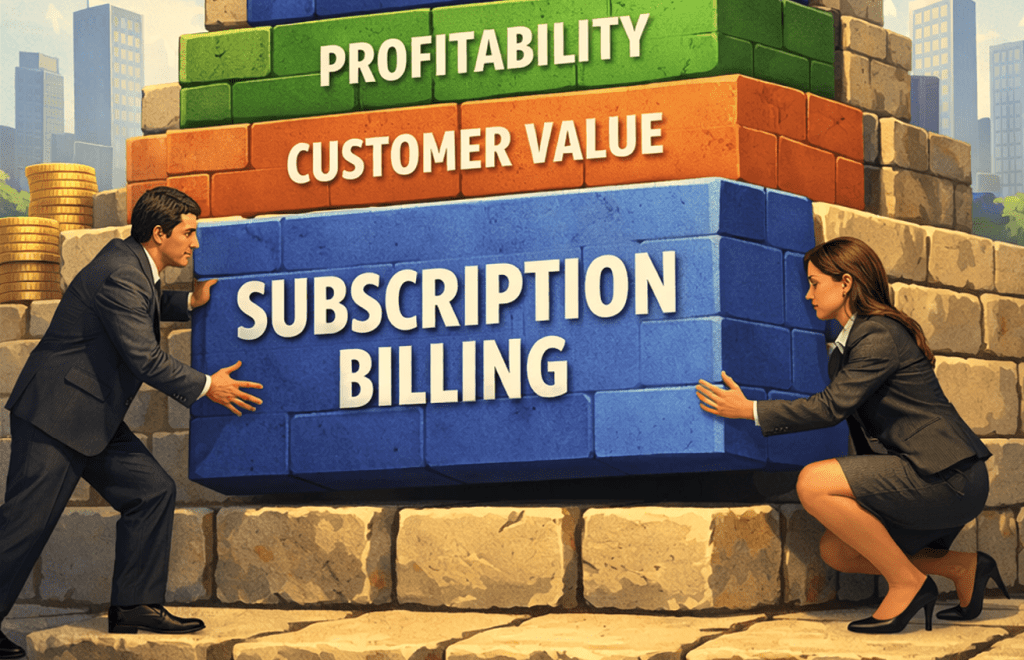
Kyle James and I recently had a conversation with Zuora, one of the early pioneers and leading platforms in subscription-based billing. They have spent more than a decade helping organizations operationalize recurring revenue models. What stood out in our discussion was a simple but critical distinction. Subscription billing technology enables recurring revenue. It does not guarantee recurring success.
Across the B2B software market and other subscription-driven industries, companies have adopted recurring billing infrastructure at scale. Platforms like Zuora provide the mechanics. They allow organizations to invoice accurately, manage subscription terms, automate renewals, and support complex pricing models. That enablement layer is foundational. However, many organizations mistakenly believe that implementing subscription billing is synonymous with building a sustainable recurring revenue engine.
The financial model tells a different story.
In traditional on-premise software environments, the majority of profit was captured at the point of sale. Once the deal closed, much of the financial risk had been realized. Subscription economics invert that model. Customer acquisition costs are incurred upfront through marketing, sales, onboarding, and implementation investments. In many B2B software companies, it takes twelve to eighteen months for a customer to reach break-even. Profitability only begins after that threshold.
If a customer churns before that break-even window, the organization does not simply lose future revenue. It loses money.
This is where the disconnect often appears. Companies continue to operate with an acquisition-first mindset. Sales teams are optimized for bookings. Marketing is optimized for pipeline. Executive dashboards highlight new logo growth. Meanwhile, insufficient structural attention is placed on retention, product adoption, and long-term engagement.
Recurring revenue models demand a different operating philosophy.
Winning customers is necessary. Winning the right customers is critical. Sales organizations must be incentivized not just to close deals, but to qualify rigorously for long-term fit. Compensation structures can be aligned to retention milestones. Early churn clawbacks can reinforce accountability. Promotion pathways can incorporate churn performance as a measurable metric. These mechanisms shift behavior from short-term revenue capture to long-term value creation.
Customer success must also be architected as a revenue function rather than a support function. Proactive onboarding, structured value realization plans, and continuous usage monitoring directly influence lifetime value. Product engagement data can serve as a leading indicator of churn risk. When usage drops below defined thresholds, intervention should be automatic and coordinated.
Cross-functional alignment is equally important. Warm handoffs between sales and customer success create continuity. Clear expectations during the sales cycle reduce downstream friction. Shared accountability for retention ensures that departments are not operating in silos.
This is where the conversation with Zuora becomes especially relevant. Subscription billing platforms enable pricing flexibility, renewal management, and revenue recognition discipline. They provide visibility into recurring revenue streams and customer lifecycle metrics. When integrated properly into the broader operating model, they become strategic infrastructure rather than back-office tools.
However, technology alone cannot compensate for misaligned incentives or poor customer qualification. Subscription billing platforms like Zuora are powerful enablers. The organizations that succeed are those that pair that infrastructure with cultural and operational alignment around retention.
Recurring revenue works when churn is minimized and lifetime value expands over time. Once a customer surpasses the break-even period and remains engaged for multiple years, acquisition costs become diluted and profitability compounds. At that point, recurring revenue transforms from a billing structure into a durable growth engine.
The companies that will outperform in the subscription economy are not simply those that implement subscription billing software. They are the ones that redesign their compensation models, customer success frameworks, onboarding rigor, and qualification standards to support long-term customer viability.
Subscription billing enables the model. Organizational alignment sustains it.