All business leaders have been there: a candidate looks great on paper, so you invest in hiring them, but once on board, they fail to meet expectations.
50% of today’s workers are digital natives, and with this number expected to increase to 75% over the next five years, most organizations still rely on outdated screening methods—résumés, interviews, and post-offer background checks—that are ill-equipped to capture behavioral red flags that often appear online but not on paper.
From disclosing company information to violating safety protocols to harassing others, new hires with less visible issues, such as intolerance, tardiness, or substance abuse problems, can misalign with company policies or culture, jeopardizing your team’s productivity or your brand image. In-person interviews can fall short when you need to know a potential hire’s true character and fit, especially when the stakes are high.
As 3Sixty Insights recently found in our new research note covering the work of behavior intelligence leader, Fama, companies can use behavioral insights technology to evaluate candidate risk and cultural fit. Online screenings fill the gap left by traditional hiring methods. Using insights from analysis of over 10,000 public web sources, such as social media presences and credible news articles, Fama’s business intelligence solution helps employers identify risky behavior aligned with customizable categories, including violence, threats, sexual misconduct, online harassment and trolling, drug use, prejudice, and intolerance.
The Need for Social Media Screening & Behavioral Insights is On the Rise
According to Fama’s 2025 Misconduct Benchmark Report, the rate of workplace misconduct increased by 34% between 2024 and 2025. Most adverse content was flagged for online harassment, intolerance, or sex-related misconduct. Additionally, 10% of adverse posts last year were flagged for threats or violence.
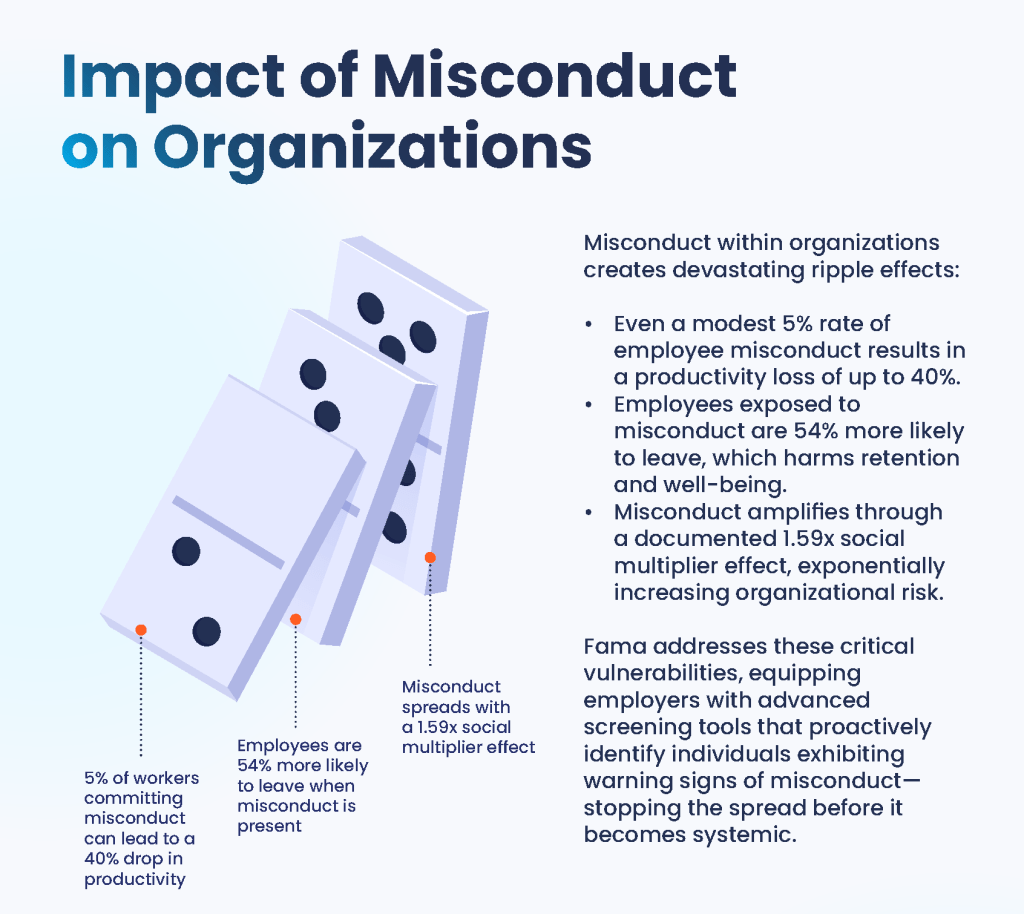
The consequences of these numbers can ripple across organizations in a number of ways. A 5% rate of employee misconduct can cause a 40% drop in productivity, but the domino effect is that any employee in the same organization becomes 54% more likely to leave.
Because misconduct behavior spreads internally with a documented social multiplier effect of 1.59, even a small amount of toxicity can have impacts across performance, retention, and culture. These statistics underscore the far-reaching implications of misconduct, extending beyond individual behavior and into organizational effectiveness, stability, employee morale, and safety.
Mercer has also identified misconduct as one of the top five people risks, emphasizing that people risks are also financial risks. Since workplace misconduct risks can double under organizational stress or economic uncertainty, understanding these behaviors proactively enables organizations to identify and mitigate the root causes of misconduct, promoting healthier and more resilient workplace cultures.
The rise in workplace misconduct also highlights a shift from mere acceptance to active advocacy. Common warning signs include trolling, online harassment, intolerance, and inappropriate behavior, which a solid résumé or positive interview may mask. As noted by Harvard Business Review, interviews are imperfect predictors of job performance, frequently failing to capture soft skills or cultural fit.
These findings underscore the importance of proactive investment in behavioral signals solutions to mitigate legal exposure and compliance risks.
Filling Gaps Left by Traditional Hiring Methods
As behavioral insights become more robust, they will become increasingly accurate at uncovering nuanced traits, such as interpersonal skills, decision-making, and alignment with organizational values. In contrast to traditional methods, proactively identifying warning signs of misconduct through business intelligence enables organizations to prevent widespread cultural erosion before it begins and ensure peace of mind.
By screening for personality traits and behavioral flags, these insights give hiring teams objective, data-backed evidence of whether a candidate may pose a threat to workplace safety, brand reputation, or team cohesion. This shifts hiring decisions away from personal intuition and towards evidence-based judgment.
Ethical and Compliant AI Screening
As organizations turn to behavioral insights in hiring, they must prioritize compliance, ethics, and transparency to ensure a robust hiring process. Compliant data handling is necessary to avoid potential discrimination, privacy violations, and negligence issues in online screenings. Today, nearly three-quarters of employers conduct web searches on candidates that are often not compliant, potentially exposing the employer to legal action.
Businesses using a customizable, configurable third-party screening provider like Fama benefit from their partner’s status as a consumer reporting agency under the Fair Credit Reporting Act (FCRA). This means that Protected Class Information, such as race, gender, age, and religion, from screenings and analyses is omitted from searches to protect employers from compliance issues while maintaining fairness based solely on the relevant criteria for candidate evaluations.
Fama also encourages clients to establish clear internal policies with agreed-upon codes of conduct and provide ongoing training, ensuring that teams use behavioral insights thoughtfully, legally, and without bias. This way, although it provides insights, the employer remains in the driver’s seat when it comes to determining what constitutes good or bad behavior and what harms or benefits their business.
Final Thoughts
In an era where company culture can go viral for all of the wrong reasons, the ability to identify misconduct before Day One is a competitive advantage. For these reasons, I believe behavioral intelligence is set to permanently change how candidates are found, vetted, and hired.
All of this is not to say that AI and behavioral intelligence should replace human decision-making in hiring, however. While AI can automate repetitive administrative HR tasks and help comb through data, human judgment remains essential for managing biases, ethics, and nuanced insights, and should remain the bedrock of the hiring and HR space.