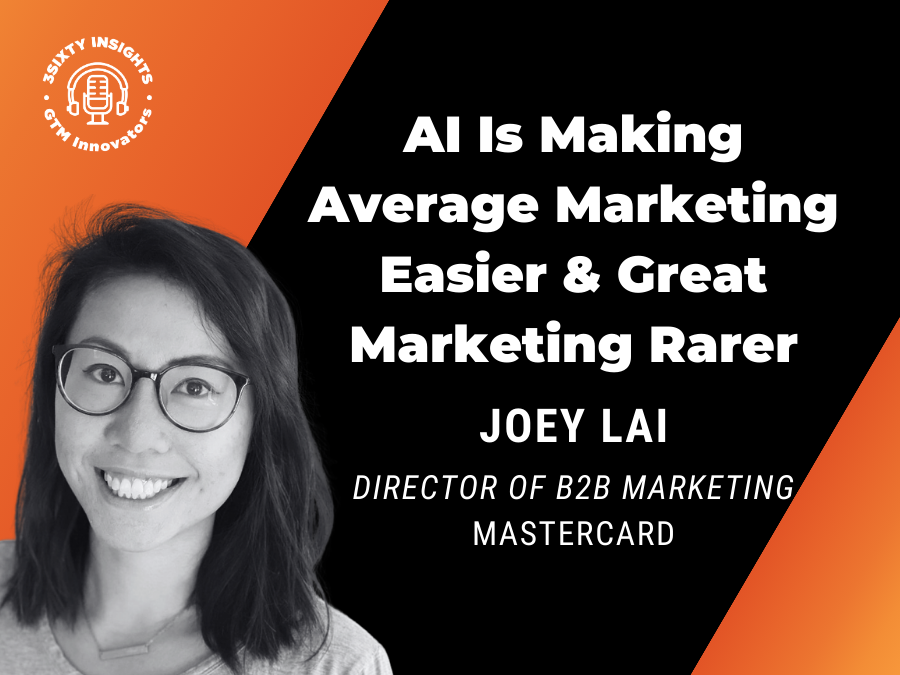
Why critical thinking is becoming marketing’s most valuable skill
AI has changed marketing faster than almost any technology before it.
In a matter of months, tools like ChatGPT, Copilot, and Claude have made it possible to generate campaigns, content, ads, and messaging variations at a speed that would have been unthinkable just a few years ago. For many teams under pressure to do more with less, that speed feels like a lifeline.
But there’s a quieter question emerging beneath the hype:
If marketing is getting easier to execute, why does so much of it feel increasingly forgettable?
That tension sat at the center of a recent GTM Innovators conversation with Joey Lai, B2B Marketing Director at Mastercard. What followed wasn’t an anti-AI rant, but something far more interesting: a reflection on how AI is changing what gets produced, who produces it, and what skills actually matter as a result.
AI Has Made Output Cheaper, Not Insight Better
One of the most important distinctions Joey surfaced is that AI excels at replication, not originality.
“AI enables a volume game,” she explained. “It allows you to produce more, faster. But that doesn’t mean it’s higher quality. And often it’s the opposite.”
The danger isn’t that AI produces bad content. It’s that it produces acceptable content. Content that looks polished, checks the boxes, and fills the pipeline. Content that is good enough to ship, but not strong enough to stand out.
When every marketer has access to the same models trained on the same inputs, differentiation doesn’t come from speed or scale anymore. It comes from judgment.
As Joey put it, “As good as your prompt might be, have you actually done the thinking? Have you got the differentiated message? Have you connected the insight to something human?”
That’s the paradox. AI removes friction from execution, but it doesn’t remove the need for insight. It just makes it easier to skip.
Critical Thinking Is Becoming the Real Competitive Advantage
Nowhere is that risk more visible than in how newer marketers are entering the field.
Joey shared a hiring story that stopped the conversation cold. A junior candidate submitted a campaign plan generated almost entirely by AI. The structure was fine. The language was competent. But the candidate had removed the most interesting parts of the AI-generated output and presented something flatter and more generic.
“The task wasn’t hard,” Joey said. “But she didn’t know what the good bits were. She didn’t know what to lean into or why.”
That’s the quiet cost of premature automation. When people rely on AI before they’ve built taste, pattern recognition, or storytelling instincts, they don’t just move faster. They stagnate.
Research already suggests that overreliance on AI in learning environments reduces critical thinking over time. In marketing, that shows up as an inability to explain why something works, not just what was produced.
And that has downstream consequences. Teams lose originality. Brands lose voice. Leaders inherit talent that can execute but can’t think.
Great Marketing Still Comes From Human Connection
What makes this conversation compelling is that it doesn’t end in pessimism.
Joey is clear-eyed about the reality: AI isn’t going away. It will become more embedded, more capable, and more expected. The question isn’t whether marketers should use it, but how.
Her answer is simple and uncomfortable: don’t outsource the hard parts.
The work that builds great marketers hasn’t changed. It still comes from:
- Deeply understanding customers as people, not personas
- Connecting insights across sales conversations, culture, and context
- Spending time thinking before producing
- Building relationships inside and outside the organization
“It’s tempting to skip the learning process,” Joey admitted. “But that learning is what gives you the ability to create something meaningful in the first place.”
AI can draft, summarize, test, and optimize. But it can’t replace curiosity. It can’t replicate lived experience. And it can’t tell you what matters.
That responsibility still sits squarely with humans.
The Real Question for GTM Leaders
For GTM leaders, this creates a new challenge.
- How do you encourage AI adoption without training teams to avoid thinking?
- How do you reward speed without sacrificing originality?
- How do you develop marketers who can use AI without depending on it?
The answers won’t come from tools alone. They’ll come from culture, coaching, and clarity about what great marketing actually looks like.
Because in an AI-saturated world, average will be abundant.
Great will be rare.
And the marketers who stand out won’t be the ones who shipped the fastest. They’ll be the ones who thought the hardest.
Want to Go Deeper?
This article only scratches the surface of the conversation.
In the full GTM Innovators episode, Joey Lai and I explore:
- Why “good enough” marketing is a hidden risk
- How leaders can develop critical thinking in AI-heavy teams
- Where AI helps, where it hurts, and where humans still matter most
Listen to or watch the full episode:
Why AI Is Making Average Marketing Easier and Great Marketing Rarer